

If you've relocated to Malaysia for work, you already know the awkward part of the conversation. One of you got the job offer. The other got a Dependant Pass and a career on pause.
That's changing. From 1 January 2027, spouses of Category I Employment Pass holders who hold a valid Dependant Pass will be allowed to work in Malaysia, subject to conditions the government has yet to publish.
Prime Minister Datuk Seri Anwar Ibrahim announced it on 9 October 2026 while tabling Budget 2027. It's a small line in a very large budget speech, but if you're the trailing spouse in a Kuala Lumpur relocation, it's probably the most important line in it.
Here's what we know, what's still unconfirmed, and what you can usefully do before January.
What's actually changing on 1 January 2027
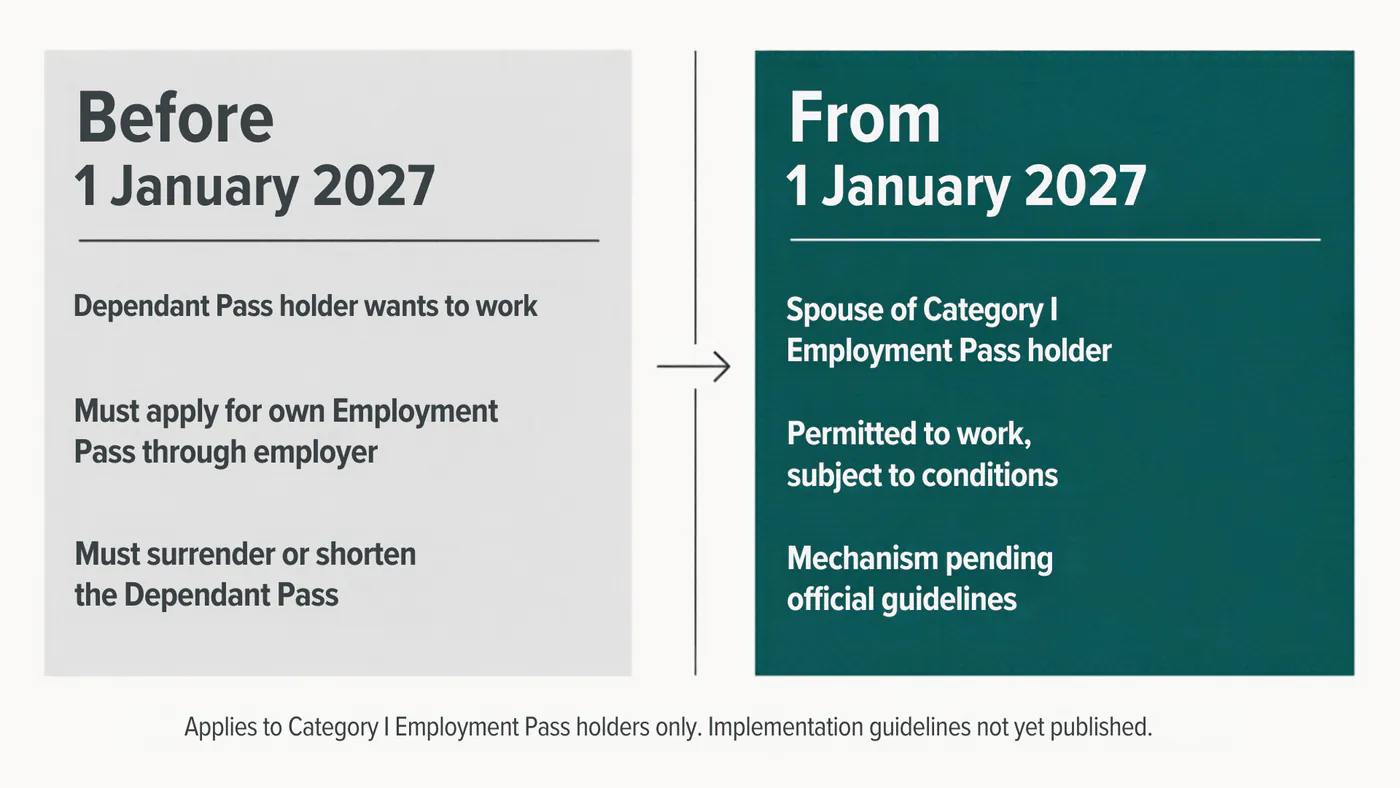
Right now, a Dependant Pass lets you live in Malaysia. It doesn't let you work.
If you hold a Dependant Pass and you want a job, the current route is unforgiving. You apply for your own Employment Pass through the hiring company, and you surrender or shorten your Dependant Pass, because Malaysian immigration rules allow a person to hold only one pass at a time. In practice that means finding an employer willing to sponsor you at Employment Pass salary levels before you can take the job at all.
From January 2027, eligible spouses get a different route. The announcement says they'll be permitted to work, subject to stipulated conditions.
It does not say the Dependant Pass becomes a work pass by itself. That distinction matters, and we'll come back to it.
 (opens full-size image in a new tab)
Who qualifies
Three things need to be true:
- The principal expatriate holds a valid Category I Employment Pass.
- The spouse holds a valid Dependant Pass.
- The spouse meets whatever conditions the authorities prescribe.
That third condition is doing a lot of work, and nobody can describe it yet.
The announcement names Category I only. If your partner holds a Category II or Category III Employment Pass, this doesn't apply to you, and you shouldn't plan around it. The same goes for children, parents and other family members on dependant-related passes.
Are you actually Category I?
Plenty of people assume they know their category and get it wrong, particularly after the thresholds moved last year.
Malaysia revised its Employment Pass salary framework on 1 June 2026. For applications and renewals submitted from that date:
| Category | Minimum basic monthly salary | Maximum duration |
|---|---|---|
| Category I | RM20,000 and above | Up to 10 years |
| Category II | RM10,000 to RM19,999 | Up to 10 years, succession plan required |
| Category III | RM5,000 to RM9,999 (RM7,000 in manufacturing) | Up to 5 years, succession plan required |
Before June 2026, Category I started at RM10,000. The threshold doubled.
So if your partner was approved as Category I some years ago and hasn't renewed since, their category on the current pass is what counts, not what the salary would qualify for today. Check the pass itself. Don't work it out from the payslip.
One more thing worth knowing: the same June 2026 reform extended Dependant Pass eligibility to Category III holders, who previously had none. More families can now bring a spouse to Malaysia than before. Fewer of those spouses will be able to work. Those two changes pull in opposite directions, and it's worth being clear-eyed about which side of the line your household sits on.
Will your spouse still need a separate Employment Pass?
This is the question everyone is asking, and the honest answer is that the government hasn't said.
Two published positions currently sit side by side. The Expatriate Services Division states that a Dependant Pass holder who wants to work must apply for an Employment Pass through a company, and must surrender or shorten the Dependant Pass to do it. Separately, Malaysia already operates endorsement-style work permissions in other contexts, where the holder keeps their existing pass and receives authorisation to work on top of it.
Two Malaysian precedents suggest where this is heading:
- Spouses of Malaysian citizens on a Long-Term Social Visit Pass can work without converting the pass. They obtain a work endorsement in the passport from the Immigration Department, supported by an application letter, a letter of appointment, a marriage certificate and the valid pass.
- Spouses of Residence Pass-Talent holders can also seek employment without applying for a separate Employment Pass, once the relevant work endorsement is in place.
If ESD follows either model, the mechanism for Category I spouses will be an endorsement rather than a pass conversion. That would be the practical outcome, because it removes the need to give up residency rights in order to accept a job.
Our reading, not a rule. We're reading the signals here, not quoting a rule. Until the circular lands, treat it as the likely shape of things and nothing firmer.
What's still unanswered
If you're planning around this, these are the gaps:
- Will the spouse need a confirmed job offer before applying for authorisation?
- Will the spouse's own salary have to meet an Employment Pass threshold, or can they be hired at normal market rates for the role?
- Will employers have to advertise the vacancy on the MYFutureJobs portal for 30 days first?
- Are freelancing, consulting and company directorships included, or only standard employment contracts?
- What happens to the spouse's work authorisation if the principal's Employment Pass ends?
On the MYFutureJobs question there's a reasonable inference available. SOCSO's own expatriate guidance states that the 30-day advertising policy applies to Employment Pass recruitment, and that Dependant Pass, Professional Visit Pass and Residence Pass-Talent fall outside it. So if the new route runs through a Dependant Pass endorsement, local advertising shouldn't attach. If it runs through a modified Employment Pass, it probably will, subject to the existing exemption routes.
On the last point, be realistic. Every spouse work right in Malaysia is tied to the principal's pass. If the principal's Employment Pass is cancelled or not renewed, the Dependant Pass goes with it, and so does anything built on top of it.
The money side nobody mentions
A second salary changes your household budget, and it changes your employer's cost model too. A few things to factor in.
Income tax. Your spouse becomes a Malaysian tax resident if they're in the country for 182 days or more in a calendar year, which almost all accompanying spouses are. That puts them on resident progressive rates rather than the flat non-resident rate, and gives them access to individual tax reliefs. Budget 2027 also raises individual tax relief and cuts rates for two middle-income bands, so a second income in 2027 is taxed more kindly than the same income in 2026 would have been.
EPF and SOCSO. On statutory contributions, the picture changed recently. EPF became mandatory for non-Malaysian employees under 75 from the October 2025 wage month, at 2 percent from the employer and 2 percent from the employee. Foreign employees sit under SOCSO's Employment Injury Scheme and are generally outside EIS. Any employer quoting your spouse a package should already have this built in.
None of this is a reason to delay. It's a reason to read the offer properly when it comes.
What to do between now and January
If you're already in Malaysia
- Check your category and dates. Look at the Employment Pass category on the physical pass, not the salary. Then check the Dependant Pass expiry date and whether it falls before or after January, because a renewal in the middle of a new policy rollout is the kind of timing you want to know about in advance.
- Put the paperwork in one folder. Marriage certificate, degree certificates, professional registrations and an updated CV are what a work authorisation will almost certainly ask for. If your qualifications were issued outside Malaysia, find out now whether they need certification or apostille, because that process takes weeks and nobody budgets for it.
- Watch the official channels and nothing else. The Expatriate Services Division and the Immigration Department will publish the procedure. Immigration agents posting confident application steps in December will be guessing.
If you're moving to Malaysia in 2027
You've got more to arrange than immigration paperwork, and the immigration part is the one you have least control over.
Start with where you'll live, because a working spouse changes the calculation. A household with one commuter can live further out. A household with two needs to think about both commutes, and that usually pushes you toward KL city centre, Petaling Jaya, Mont Kiara or Cyberjaya depending on the industries involved. Our guide to renting in Malaysia for foreigners covers the tenancy framework and the deposits you'll be asked for.
Work out what's coming with you. A two-income household that expects to stay five years ships differently from a family treating it as a two-year posting. International relocation from most origins runs on either a full container or shared groupage, and the choice is mostly about volume and timing.
Then sequence it. Our moving checklist sets out what needs doing at eight weeks, four weeks and one week out.
If you're an employer or HR mobility team
Identify which of your expatriate staff hold Category I passes, and which of those have an accompanying spouse on a Dependant Pass. That's your pool, and it's also a recruitment pool for roles you're struggling to fill locally.
Review your recruitment and onboarding process so you're ready to act in January rather than starting then. And don't promise spouse employment rights in an offer letter until the procedure is published. Corporate relocation and employee group relocation are where we spend most of our time with mobility teams, and the single most common problem is a commitment made before the rules were confirmed.

Why this matters more than it looks
Malaysia is competing for the same senior executives as Singapore, Dubai and Hong Kong, and it's been losing some of them on exactly this point.
Budget 2027 didn't announce the spouse measure in isolation. It came alongside a two-year extension for digital nomad pass holders who've hit the two-year limit, a five working day Employment Pass processing target for listed MyABE companies, and strengthened incentives under the Global Services Hub scheme from the same date. Read together, that's a package aimed at regional headquarters in Greater Kuala Lumpur.
For the households inside that policy, the effect is simpler. It removes one of the real reasons people turn down a posting to KL.
Planning a move to Malaysia with Florette Relocations
We've handled over 1,000 moves out of Kuala Lumpur since 2016, and a good share of them are expatriate families arriving on an Employment Pass with a spouse and school-age children in tow.
What we do:
- Door-to-door international moving, full container and shared groupage
- Professional packing and customs clearance coordination
- Inbound relocation services for families arriving in Malaysia
- Expat relocation support including home search, school search and settling-in
- Local moves across Kuala Lumpur, Petaling Jaya and Cyberjaya once you're here
Moving to Malaysia in 2027?
Every quote includes a free survey and comes back within 24 hours, in writing.